Article

Morphology and niche evolution influence hummingbird speciation rates

Barreto et al. (2023) – Proceedings B

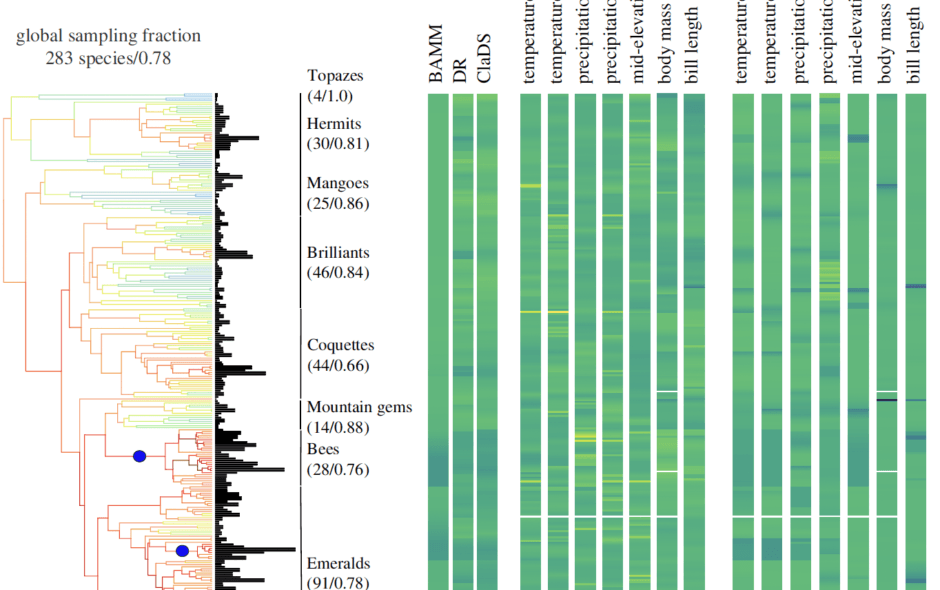
How traits affect speciation is a long-standing question in evolution. We investigate whether speciation rates are affected by the traits themselves or by the rates of their evolution, in hummingbirds, a clade with great variation in speciation rates, morphology and ecological niches. Further, we test two opposing hypotheses, postulating that speciation rates are promoted by trait conservatism or, alternatively, by trait divergence. To address these questions, we analyse morphological (body mass and bill length) and niche traits (temperature and precipitation position and breadth, and mid-elevation), using a variety of methods to estimate speciation rates and correlate them with traits and their evolutionary rates. When it comes to the traits, we find faster speciation in smaller hummingbirds with shorter bills, living at higher elevations and experiencing greater temperature ranges. As for the trait evolutionary rates, we find that speciation increases with rates of divergence in the niche traits, but not in the morphological traits. Together, these results reveal the interplay of mechanisms through which different traits and their evolutionary rates (conservatism or divergence) influence the origination of hummingbird diversity.

https://doi.org/10.1098/rspb.2022.1793

Article

Accelerated body size evolution in upland environments is correlated with recent speciation in South American freshwater fishes

Cerezer et al. (2023) – Nature Communications

Speciation rates vary greatly among taxa and regions and are shaped by both biotic and abiotic factors. However, the relative importance and interactions of these factors are not well understood. Here we investigate the potential drivers of speciation rates in South American freshwater fishes, the most diverse continental vertebrate fauna, by examining the roles of multiple biotic and abiotic factors. We integrate a dataset on species geographic distribution, phylogenetic, morphological, climatic, and habitat data. We find that Late Neogene-Quaternary speciation events are strongly associated with body-size evolution, particularly in lineages with small body sizes that inhabit higher elevations near the continental periphery. Conversely, the effects of temperature, area, and diversity-dependence, often thought to facilitate speciation, are negligible. By evaluating multiple factors simultaneously, we demonstrate that habitat characteristics associated with elevation, as well as body size evolution, correlate with rapid speciation in South American freshwater fishes. Our study emphasizes the importance of integrative approaches that consider the interplay of biotic and abiotic factors in generating macroecological patterns of species diversity.

https://www.nature.com/articles/s41467-023-41812-7