Article

Biodiversity Patterns Redefined in Environmental Space

Biodiversity Patterns Redefined in Environmental Space

Graham et al. (2025) – Ecology Letters

Biodiversity Patterns Redefined in Environmental Space

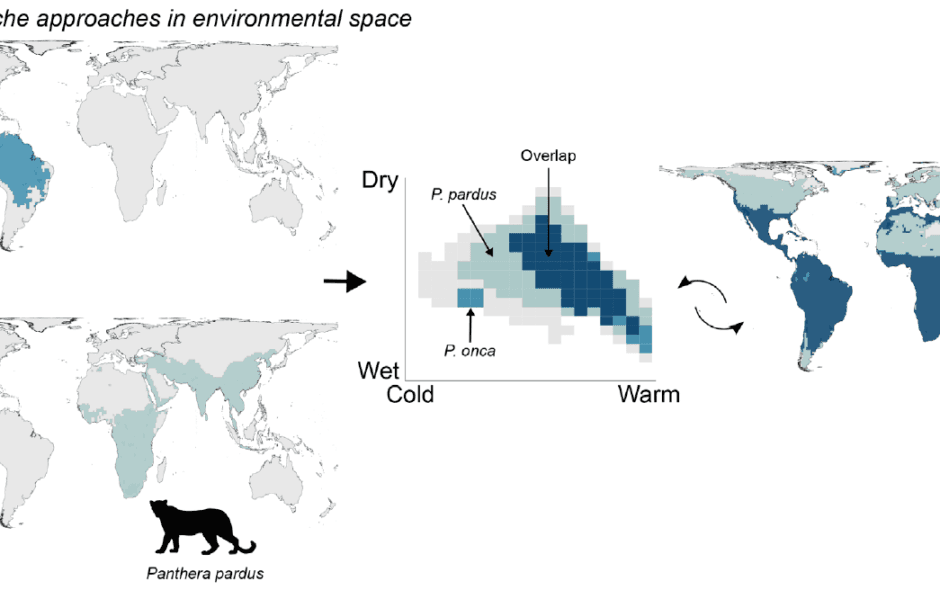
Ecological and evolutionary questions addressing diversity-environment relationships have been evaluated almost entirely in geographic space, yet most hypotheses are formulated in terms of environmental conditions. Recent examples evaluating macroecological patterns directly in environmental space suggest that such refocusing provides different perspectives on the mechanisms driving broad-scale patterns of diversity. Yet, we lack both conceptual frameworks and targeted studies to fully evaluate the potential contribution of such a refocus. Here, we focus on the concept of environmental space by briefly reviewing its use in ecology and evolution and suggesting avenues for further development. We encourage a re-evaluation of hypotheses and frameworks that have dominated ecological theory since the foundations of ecology with a very simple shift in the lens, that is, from geographical to environmental space. Focusing on environmental space also provides a crucial lens for climate change research, enabling a comprehensive evaluation of biodiversity dynamics and offering a holistic view of the interplay between species and their evolving environments. This shift enhances our ability to predict and adapt to future changes, enriching our understanding of biodiversity beyond more commonly done geographic analyses. Additionally, it aligns with the broader discourse on Biodiversity Patterns Redefined in Environmental Space.

https://doi.org/10.1111/ele.70008

Article

The contribution of mutualistic interactions to functional and phylogenetic diversity

Dehling, Barreto & Graham (2022) – Trends in Ecology and Evolution

Highlights

  • Species interactions are key for maintaining biodiversity and the functioning of ecological communities.
  • Despite the importance of species interactions for ecological communities, there is currently no method to quantify the contribution of individual species to maintaining functional diversity (FD) and phylogenetic diversity (PD) via their interactions with other species.
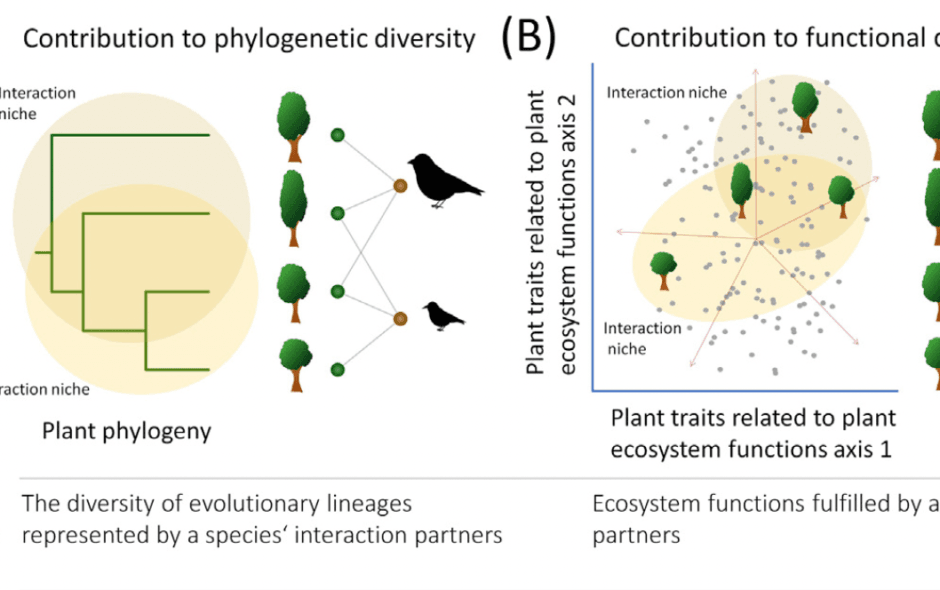
  • Species’ interaction niches – the FD and PD of their interaction partners – measure the contribution of mutualists to conserving ecosystem functions and evolutionary lineages, respectively.
  • Measuring the contribution of species to maintaining FD and PD via their mutualistic interactions will guide conservation efforts and facilitate new studies on the evolution of ecological communities.

Abstract

Reduction of functional diversity (FD) and phylogenetic diversity (PD) likely affects ecosystem functions and reduces the potential of communities to respond to changes, such as climate change. Mutualistic interactions are essential for maintaining diversity, but their role has largely been ignored in conservation planning. We propose using a species’ interaction niche – the diversity of its interaction partners – to measure a species’ contribution to the maintenance of FD and PD via mutualistic interactions, and thus identify species and interspecific interactions that are particularly important for the conservation of ecosystem functions and evolutionary lineages in ecological communities. Our approach represents a switch in perspective that allows a direct assessment of the importance of mutualistic interactions for the maintenance of biodiversity and ecosystem functioning.

https://doi.org/10.1016/j.tree.2022.05.006

Article

Effects of neutrality and productivity on mammal richness and evolutionary history in Australia

Coelho et al. (2018) – Ecography

Explaining how heterogeneous spatial patterns of species diversity emerge is one of the most fascinating questions of biogeography. One of the great challenges is revealing the mechanistic effect of environmental variables on diversity. Correlative analyses indicate that productivity is associated with taxonomic, phylogenetic, and functional diversity of communities. Surprisingly, no unifying body of theory has been developed to understand the mechanism by which spatial variation of productivity affects the fundamental processes of biodiversity. Based on widely discussed verbal models in ecology about the effect of productivity on species diversity, we developed a spatially explicit neutral model that incorporates the effect of primary productivity on community size and confronted our model’s predictions with observed patterns of species richness and evolutionary history of Australian terrestrial mammals. The imposed restrictions on community size create larger populations in areas of high productivity, which increases community turnover and local speciation, and reduces extinction. The effect of productivity on community size modeled in our study causes a higher accumulation of species diversity in productive regions even in the absence of niche-based processes. However, such a simple model is not capable of reproducing spatial patterns of mammal evolutionary history in Australia, implying that more complex evolutionary mechanisms are involved. Our study demonstrates that the overall patterns of species richness can be directly explained by changes in community sizes along productivity gradients, supporting a major role of processes associated with energetic constraints in shaping diversity patterns.

www.doi.org/10.1111/ecog.03784