Article

Area, isolation and climate explain the diversity of mammals on islands worldwide

Barreto et al. (2021) – Proceedings B

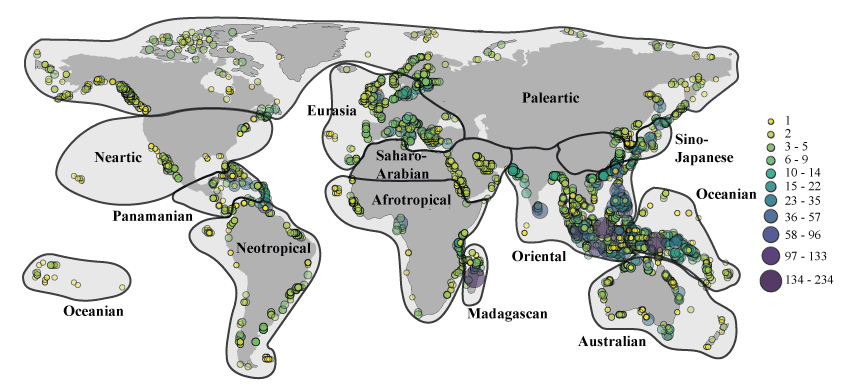
Insular biodiversity is expected to be regulated differently than continental biota, but their determinants remain to be quantified at a global scale. We evaluated the importance of physical, environmental, and historical factors on mammal richness and endemism across 5592 islands worldwide. We fitted generalized linear and mixed models to accommodate variation among biogeographic realms and performed analyses separately for bats and non-volants. Richness on islands ranged from one to 234 species, with up to 177 single island endemics. Diversity patterns were most consistently influenced by the islands’ physical characteristics. Area positively affected mammal diversity, in particular the number of non-volant endemics. Island isolation, both current and past, was associated with lower richness but greater endemism. Flight capacity modified the relative importance of past versus current isolation, with bats responding more strongly to current and non-volant mammals to past isolation. Biodiversity relationships with environmental factors were idiosyncratic, with a tendency for greater effects sizes with endemism than richness. The historical climatic change was positively associated with endemism. In line with theory, we found that area and isolation were among the strongest drivers of mammalian biodiversity. Our results support the importance of past conditions on current patterns, particularly of non-volant species.

https://doi.org/10.1098/rspb.2021.1879

Article

Environmental factors explain the spatial mismatches between species richness and phylogenetic diversity of terrestrial mammals

Barreto, Graham & Rangel (2019) – Global Ecology and Biogeography

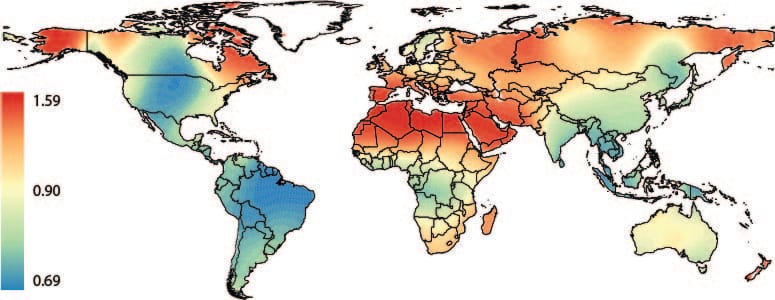
We explored the spatial variation of the relationships between species richness (SR), phylogenetic diversity (PD) and environmental factors to infer the possible mechanisms underlying patterns of mammalian diversity in different regions of the globe. We used a hexagonal grid to map SR and PD of mammals and four environmental factors (temperature, productivity, elevation and climate‐change velocity since the Last Glacial Maximum). We related those variables through direct and indirect pathways using a novel combination of path analysis and geographically weighted regression to account for spatial non-stationarity of path coefficients. We found that species richness, PD and environmental factors relate differently across the geographical space, with most relationships varying in both magnitude and direction. Species richness is associated with lower PD in much of the tropics and in the Americas, which reflects the tropical origin and the recent diversification of some mammalian clades in these regions. Environmental effects on PD are predominantly mediated by their effects on SR. But once richness is controlled for, the relationships between environmental factors and PD (i.e., PDSR) highlight environmentally driven changes in species composition. Environmental–PDSR relationships suggest that the relative importance of different mechanisms driving biodiversity shifts spatially. Across most of the globe, temperature and productivity are the strongest predictors of richness, whereas PDSR is best predicted by temperature. In conclusion, richness explains most spatial variation in PD, but both dimensions of biodiversity respond differently to environmental conditions across the globe, as indicated by the spatial mismatches in the relationships between environmental factors and these two types of diversity. We show that accounting for spatial non‐stationarity and environmental effects on PD while controlling for richness uncovers a more complex scenario of drivers of biodiversity than previously observed.

https://doi.org/10.1111/geb.12999