Article

The geography of climate and the global patterns of species diversity

Coelho et al. (2023) – Nature

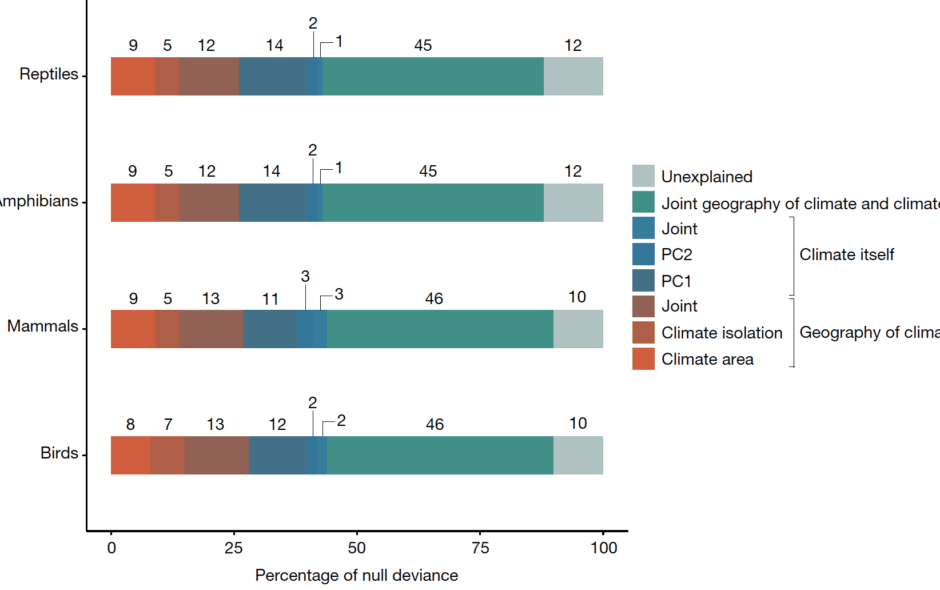
Climate’s effect on global biodiversity is typically viewed through the lens of temperature, humidity and resulting ecosystem productivity. However, it is not known whether biodiversity depends solely on these climate conditions, or whether the size and fragmentation of these climates are also crucial. Here we shift the common perspective in global biodiversity studies, transitioning from geographic space to a climate-defined multidimensional space. Our findings suggest that larger and more isolated climate conditions tend to harbour higher diversity and species turnover among terrestrial tetrapods, encompassing more than 30,000 species. By considering both the characteristics of climate itself and its geographic attributes, we can explain almost 90% of the variation in global species richness. Half of the explanatory power (45%) may be attributed either to climate itself or to the geography of climate, suggesting a nuanced interplay between them. Our work evolves the conventional idea that larger climate regions, such as the tropics, host more species primarily because of their size. Instead, we underscore the integral roles of both the geographic extent and degree of isolation of climates. This refined understanding presents a more intricate picture of biodiversity distribution, which can guide our approach to biodiversity conservation in an ever-changing world.

https://www.nature.com/articles/s41586-023-06577-5

Article

Area, isolation and climate explain the diversity of mammals on islands worldwide

Barreto et al. (2021) – Proceedings B

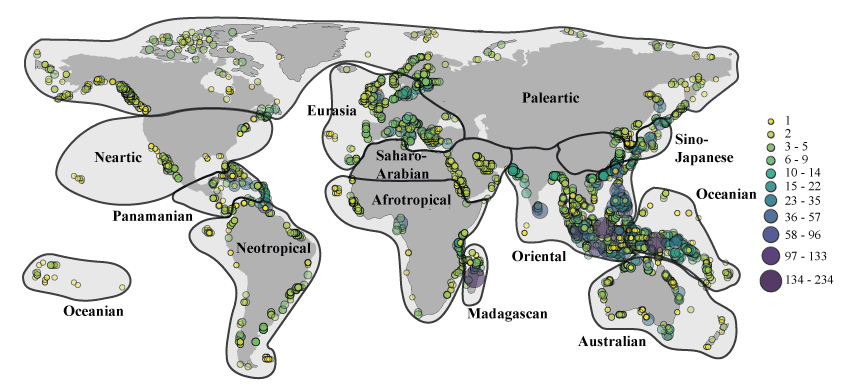
Insular biodiversity is expected to be regulated differently than continental biota, but their determinants remain to be quantified at a global scale. We evaluated the importance of physical, environmental, and historical factors on mammal richness and endemism across 5592 islands worldwide. We fitted generalized linear and mixed models to accommodate variation among biogeographic realms and performed analyses separately for bats and non-volants. Richness on islands ranged from one to 234 species, with up to 177 single island endemics. Diversity patterns were most consistently influenced by the islands’ physical characteristics. Area positively affected mammal diversity, in particular the number of non-volant endemics. Island isolation, both current and past, was associated with lower richness but greater endemism. Flight capacity modified the relative importance of past versus current isolation, with bats responding more strongly to current and non-volant mammals to past isolation. Biodiversity relationships with environmental factors were idiosyncratic, with a tendency for greater effects sizes with endemism than richness. The historical climatic change was positively associated with endemism. In line with theory, we found that area and isolation were among the strongest drivers of mammalian biodiversity. Our results support the importance of past conditions on current patterns, particularly of non-volant species.

https://doi.org/10.1098/rspb.2021.1879