Oliveira et al. (2025) – Ecography
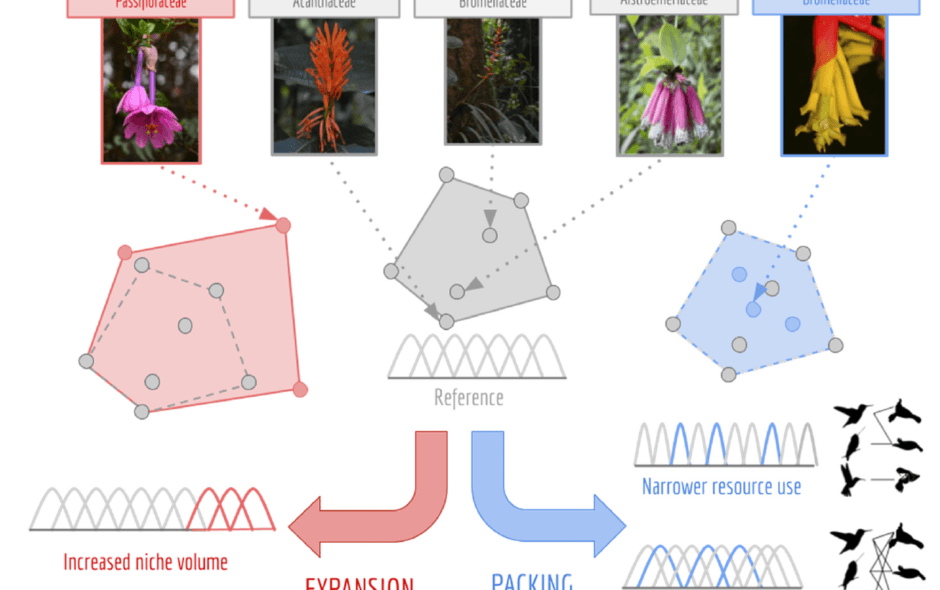
Tropical mountains often harbour high species richness. Yet the mechanisms behind such high richness remain poorly understood. One prominent hypothesis for high species richness is niche partitioning, which reduces competition and promotes coexistence. Here, we evaluate niche structure and specialisation of plant species based on the floral traits related to pollination interactions across an elevational gradient in the northern Andes. Niche structure can vary among sites, either expanding or contracting, or becoming more or less packed. We sampled eleven communities of hummingbird-visited plants along an elevation gradient in the Ecuadorian Andes and measured a series of functional traits associated with hummingbird pollination. We used the traits of all co-occurring species to calculate community weighted means, functional richness, and mean nearest neighbour distances and evaluated how they varied across elevation. Additionally, we measured specialisation based on plant–hummingbird interaction records to assess if packing is associated with narrower resource use or greater niche overlap. Species and functional richness were constant along the elevation gradient; however, niche packing was stronger at mid-elevation. We found changes in network specialisation, where the least specialised communities were those with higher niche packing. These results suggest that traits related to pollination and plant reproduction help to explain species co-occurrence and specialisation.
https://doi.org/10.1111/ecog.07440