Article

The contribution of mutualistic interactions to functional and phylogenetic diversity

Dehling, Barreto & Graham (2022) – Trends in Ecology and Evolution

Highlights

  • Species interactions are key for maintaining biodiversity and the functioning of ecological communities.
  • Despite the importance of species interactions for ecological communities, there is currently no method to quantify the contribution of individual species to maintaining functional diversity (FD) and phylogenetic diversity (PD) via their interactions with other species.
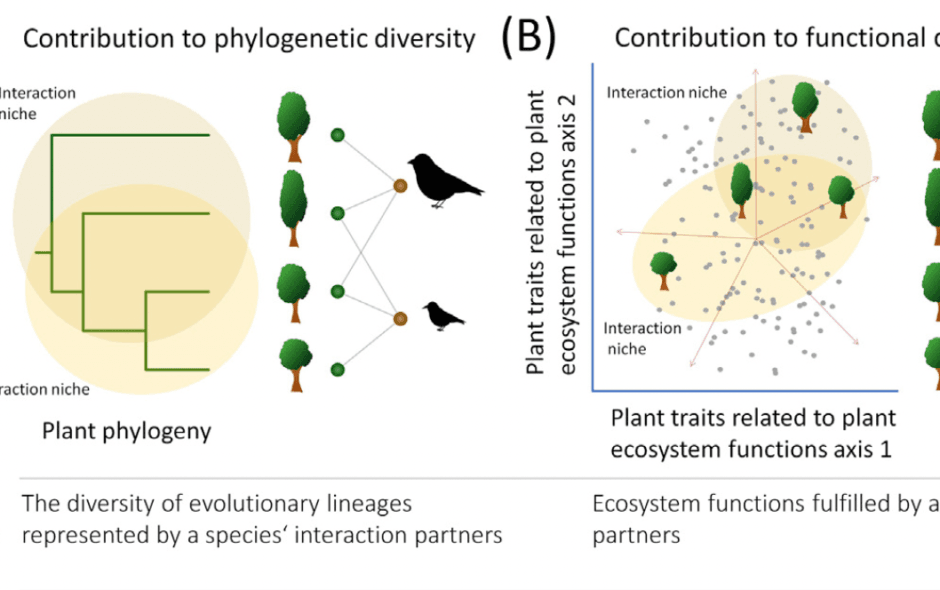
  • Species’ interaction niches – the FD and PD of their interaction partners – measure the contribution of mutualists to conserving ecosystem functions and evolutionary lineages, respectively.
  • Measuring the contribution of species to maintaining FD and PD via their mutualistic interactions will guide conservation efforts and facilitate new studies on the evolution of ecological communities.

Abstract

Reduction of functional diversity (FD) and phylogenetic diversity (PD) likely affects ecosystem functions and reduces the potential of communities to respond to changes, such as climate change. Mutualistic interactions are essential for maintaining diversity, but their role has largely been ignored in conservation planning. We propose using a species’ interaction niche – the diversity of its interaction partners – to measure a species’ contribution to the maintenance of FD and PD via mutualistic interactions, and thus identify species and interspecific interactions that are particularly important for the conservation of ecosystem functions and evolutionary lineages in ecological communities. Our approach represents a switch in perspective that allows a direct assessment of the importance of mutualistic interactions for the maintenance of biodiversity and ecosystem functioning.

https://doi.org/10.1016/j.tree.2022.05.006

Article

Turnover-driven loss of forest-dependent species changes avian species richness, functional diversity, and community composition in Andean forest fragments

Jones et al. (2021) – Global Ecology and Conservation

Andean forests, a hotspot of biodiversity, have suffered extensive fragmentation, yet we have little understanding of how this process has affected biodiversity. We surveyed bird communities across a gradient of fragment sizes (10–170 ha) and a continuous forest reference site in the Colombian Western Andes. Using a multi-species occupancy model to combine survey data from audio-visual transect surveys, mist-netting, and playbacks for owls, we estimated alpha and beta taxonomic and functional diversity. We asked whether (1) habitat amount (patch size), edge effects, or selective logging affect bird occupancy and drive changes to diversity, (2) functional and taxonomic diversity respond similarly to fragmentation, and (3) compositional changes result from species turnover or nested species loss. Species richness declined with decreasing habitat amount, increasing edge density, and increasing disturbance through selective logging. These effects were driven by the loss of forest-dependent species, which were also area sensitive: 30 such species were absent from fragments, even the largest ones (>150 ha). Area-sensitive species were also edge sensitive and increased in occupancy in unlogged forest. We further found high beta diversity (0.78) driven by species turnover (85% of dissimilarity) along the gradient. Despite extensive turnover to non-forest species within functional groups, functional trait richness and dispersion significantly declined with habitat amount. Small fragments may mimic the structure and composition of early-successional Andean forests, driving spatial turnover patterns favoring disturbance-adapted species at the expense of primary-forest specialists. Large forest reserves are therefore required to conserve forest-dependent Andean birds.

https://doi.org/10.1016/j.gecco.2021.e01922