Article

Biodiversity Patterns Redefined in Environmental Space

Biodiversity Patterns Redefined in Environmental Space

Graham et al. (2025) – Ecology Letters

Biodiversity Patterns Redefined in Environmental Space

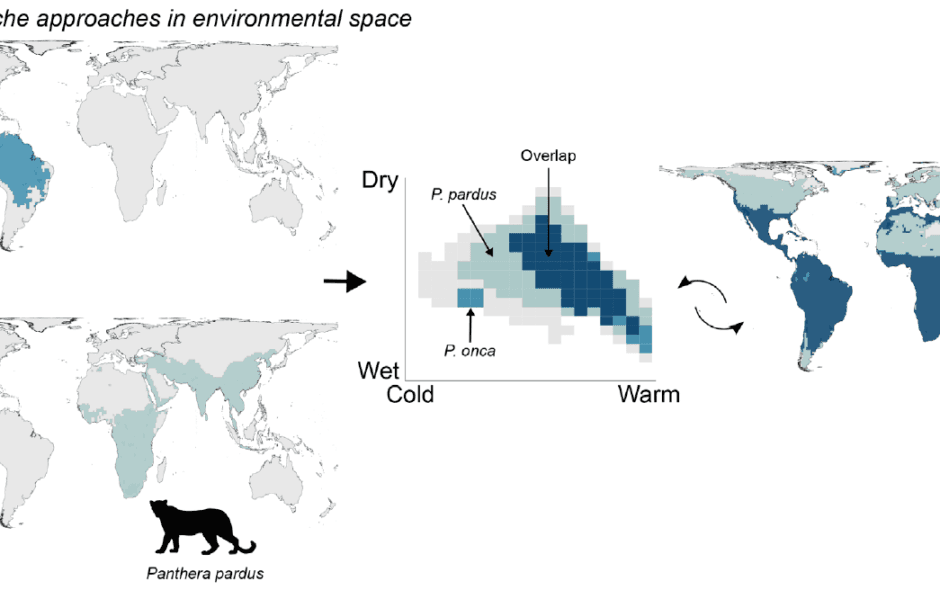
Ecological and evolutionary questions addressing diversity-environment relationships have been evaluated almost entirely in geographic space, yet most hypotheses are formulated in terms of environmental conditions. Recent examples evaluating macroecological patterns directly in environmental space suggest that such refocusing provides different perspectives on the mechanisms driving broad-scale patterns of diversity. Yet, we lack both conceptual frameworks and targeted studies to fully evaluate the potential contribution of such a refocus. Here, we focus on the concept of environmental space by briefly reviewing its use in ecology and evolution and suggesting avenues for further development. We encourage a re-evaluation of hypotheses and frameworks that have dominated ecological theory since the foundations of ecology with a very simple shift in the lens, that is, from geographical to environmental space. Focusing on environmental space also provides a crucial lens for climate change research, enabling a comprehensive evaluation of biodiversity dynamics and offering a holistic view of the interplay between species and their evolving environments. This shift enhances our ability to predict and adapt to future changes, enriching our understanding of biodiversity beyond more commonly done geographic analyses. Additionally, it aligns with the broader discourse on Biodiversity Patterns Redefined in Environmental Space.

https://doi.org/10.1111/ele.70008

Article

The geography of climate and the global patterns of species diversity

Coelho et al. (2023) – Nature

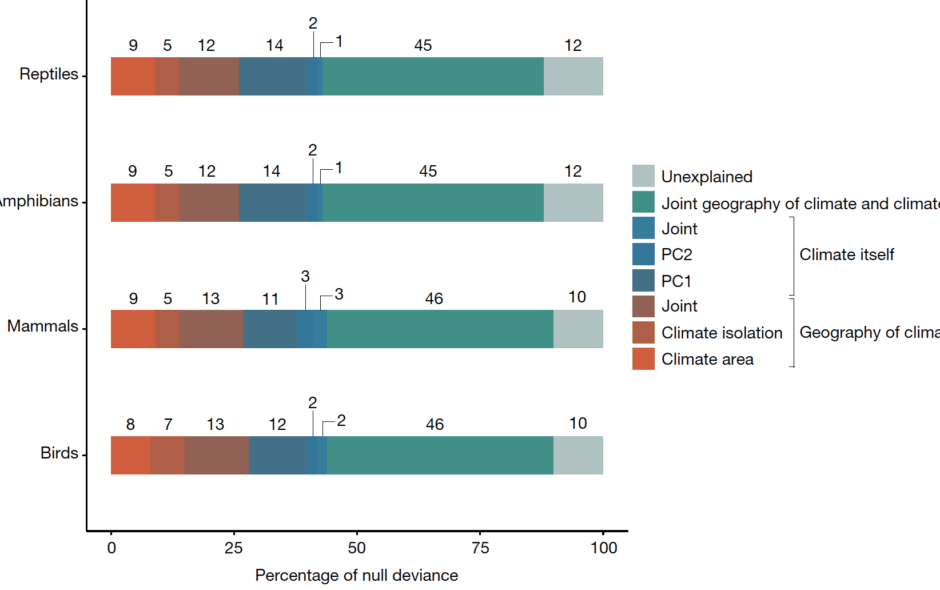
Climate’s effect on global biodiversity is typically viewed through the lens of temperature, humidity and resulting ecosystem productivity. However, it is not known whether biodiversity depends solely on these climate conditions, or whether the size and fragmentation of these climates are also crucial. Here we shift the common perspective in global biodiversity studies, transitioning from geographic space to a climate-defined multidimensional space. Our findings suggest that larger and more isolated climate conditions tend to harbour higher diversity and species turnover among terrestrial tetrapods, encompassing more than 30,000 species. By considering both the characteristics of climate itself and its geographic attributes, we can explain almost 90% of the variation in global species richness. Half of the explanatory power (45%) may be attributed either to climate itself or to the geography of climate, suggesting a nuanced interplay between them. Our work evolves the conventional idea that larger climate regions, such as the tropics, host more species primarily because of their size. Instead, we underscore the integral roles of both the geographic extent and degree of isolation of climates. This refined understanding presents a more intricate picture of biodiversity distribution, which can guide our approach to biodiversity conservation in an ever-changing world.

https://www.nature.com/articles/s41586-023-06577-5