Article

Safeguarding sloths and anteaters in the future: Priority areas for conservation under climate change

Borges et al. (2022) – Biotropica

Sloths and anteaters form the monophyletic order Pilosa, which is currently represented by only 16 extant species distributed exclusively in the Neotropics. This present-day low species richness is an inheritance of the Pleistocene megafaunal extinctions, where over 65 Pilosa species known from the fossil record went extinct. The large number of species lost in the recent past suggests that this group is greatly vulnerable to extinction. Here, we propose long-term priority conservation areas for the order Pilosa, considering different future climate change scenarios, biotic stability, and the multiple dimensions of the group’s biodiversity, such as species richness, species endemism, and phylogenetic diversity. Projections of species distribution for future scenarios show increased fragmentation and clear habitat loss as the Amazon Forest is replaced by savanna-like habitats. Conservation solutions were highly congruent for the different dimensions of biodiversity, with priority areas emerging mainly in the Atlantic Forest, Amazonian wetlands, highlands of Ecuador, and the Central American isthmus. Expanding the currently protected areas network by 6% with the proposed priority areas, independently of which future climatic scenario is considered, can increase sloths and anteaters’ coverage in the future by 12%. As a group of high phylogenetic and ecological importance, future conservation planning should deliberately aim to protect areas favorable to Pilosa, especially given the current scenario of environmental dismantling and neglect of critical Neotropical biomes.

https://doi.org/10.1111/btp.13185

Article

Environmental factors explain the spatial mismatches between species richness and phylogenetic diversity of terrestrial mammals

Barreto, Graham & Rangel (2019) – Global Ecology and Biogeography

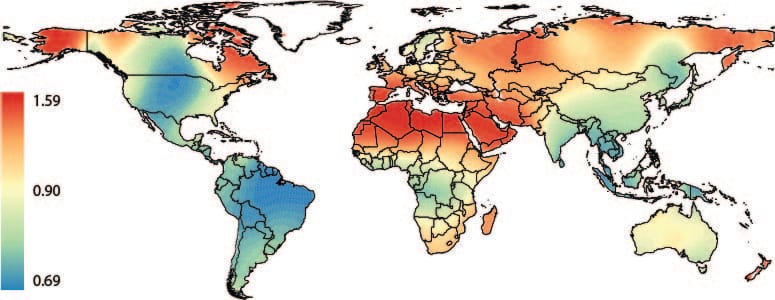
We explored the spatial variation of the relationships between species richness (SR), phylogenetic diversity (PD) and environmental factors to infer the possible mechanisms underlying patterns of mammalian diversity in different regions of the globe. We used a hexagonal grid to map SR and PD of mammals and four environmental factors (temperature, productivity, elevation and climate‐change velocity since the Last Glacial Maximum). We related those variables through direct and indirect pathways using a novel combination of path analysis and geographically weighted regression to account for spatial non-stationarity of path coefficients. We found that species richness, PD and environmental factors relate differently across the geographical space, with most relationships varying in both magnitude and direction. Species richness is associated with lower PD in much of the tropics and in the Americas, which reflects the tropical origin and the recent diversification of some mammalian clades in these regions. Environmental effects on PD are predominantly mediated by their effects on SR. But once richness is controlled for, the relationships between environmental factors and PD (i.e., PDSR) highlight environmentally driven changes in species composition. Environmental–PDSR relationships suggest that the relative importance of different mechanisms driving biodiversity shifts spatially. Across most of the globe, temperature and productivity are the strongest predictors of richness, whereas PDSR is best predicted by temperature. In conclusion, richness explains most spatial variation in PD, but both dimensions of biodiversity respond differently to environmental conditions across the globe, as indicated by the spatial mismatches in the relationships between environmental factors and these two types of diversity. We show that accounting for spatial non‐stationarity and environmental effects on PD while controlling for richness uncovers a more complex scenario of drivers of biodiversity than previously observed.

https://doi.org/10.1111/geb.12999