Article

Accelerated body size evolution in upland environments is correlated with recent speciation in South American freshwater fishes

Cerezer et al. (2023) – Nature Communications

Speciation rates vary greatly among taxa and regions and are shaped by both biotic and abiotic factors. However, the relative importance and interactions of these factors are not well understood. Here we investigate the potential drivers of speciation rates in South American freshwater fishes, the most diverse continental vertebrate fauna, by examining the roles of multiple biotic and abiotic factors. We integrate a dataset on species geographic distribution, phylogenetic, morphological, climatic, and habitat data. We find that Late Neogene-Quaternary speciation events are strongly associated with body-size evolution, particularly in lineages with small body sizes that inhabit higher elevations near the continental periphery. Conversely, the effects of temperature, area, and diversity-dependence, often thought to facilitate speciation, are negligible. By evaluating multiple factors simultaneously, we demonstrate that habitat characteristics associated with elevation, as well as body size evolution, correlate with rapid speciation in South American freshwater fishes. Our study emphasizes the importance of integrative approaches that consider the interplay of biotic and abiotic factors in generating macroecological patterns of species diversity.

https://www.nature.com/articles/s41467-023-41812-7

Article

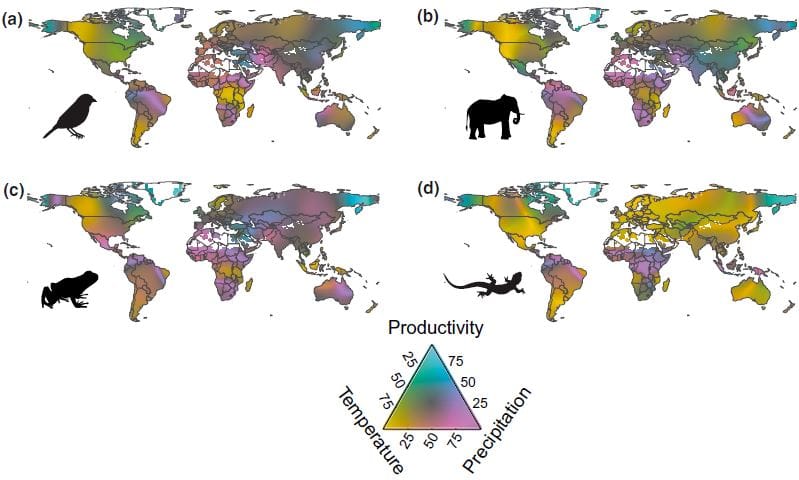
Spatial variation in direct and indirect effects of climate and productivity on species richness of terrestrial tetrapods

Barreto et al. (2021) – Global Ecology and Biogeography

We aimed to dissect the spatial variation of the direct and indirect effects of climate and productivity on the global species richness of terrestrial tetrapods. We used a geographically weighted path analysis to estimate and map the direct and indirect effects of temperature, precipitation and primary productivity on species richness of terrestrial tetrapods across the globe. We found that all relationships shift in magnitude, and even in direction, among taxonomic groups, geographical regions and connecting paths. Direct effects of temperature and precipitation are generally stronger than both indirect effects mediated by productivity and direct effects of productivity. Richness gradients seem to be driven primarily by the effects of climate on organismal physiological limits and metabolic rates rather than by the amount of productive energy. Reptiles have the most distinct relationships across tetrapods, with a clear latitudinal pattern in the importance of temperature versus water.

http://www.doi.org/10.1111/geb.13357