Article

Biodiversity Patterns Redefined in Environmental Space

Biodiversity Patterns Redefined in Environmental Space

Graham et al. (2025) – Ecology Letters

Biodiversity Patterns Redefined in Environmental Space

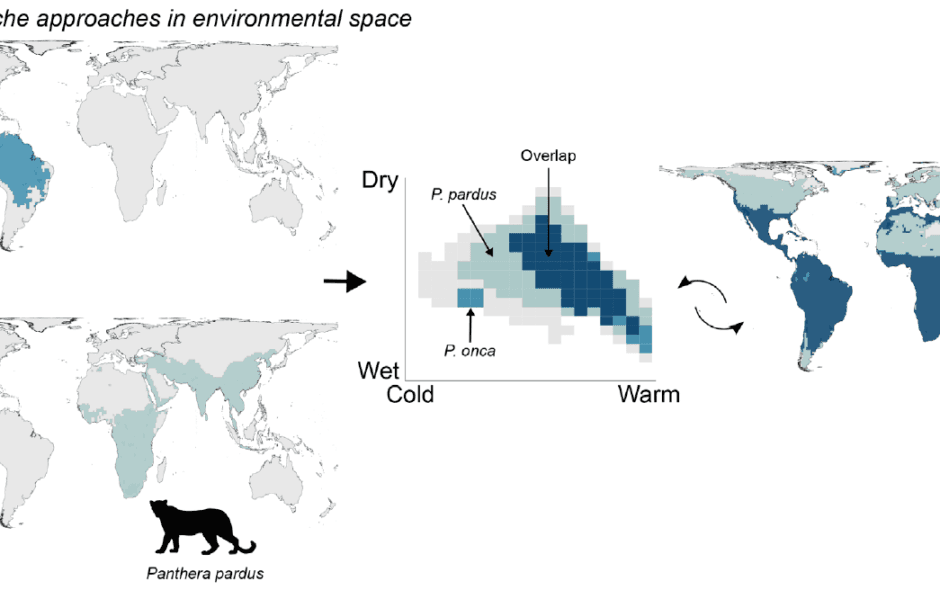
Ecological and evolutionary questions addressing diversity-environment relationships have been evaluated almost entirely in geographic space, yet most hypotheses are formulated in terms of environmental conditions. Recent examples evaluating macroecological patterns directly in environmental space suggest that such refocusing provides different perspectives on the mechanisms driving broad-scale patterns of diversity. Yet, we lack both conceptual frameworks and targeted studies to fully evaluate the potential contribution of such a refocus. Here, we focus on the concept of environmental space by briefly reviewing its use in ecology and evolution and suggesting avenues for further development. We encourage a re-evaluation of hypotheses and frameworks that have dominated ecological theory since the foundations of ecology with a very simple shift in the lens, that is, from geographical to environmental space. Focusing on environmental space also provides a crucial lens for climate change research, enabling a comprehensive evaluation of biodiversity dynamics and offering a holistic view of the interplay between species and their evolving environments. This shift enhances our ability to predict and adapt to future changes, enriching our understanding of biodiversity beyond more commonly done geographic analyses. Additionally, it aligns with the broader discourse on Biodiversity Patterns Redefined in Environmental Space.

https://doi.org/10.1111/ele.70008

Article

Niche packing, but not niche expansion, explains the co-occurrence of hummingbirds-visited plants

Oliveira et al. (2025) – Ecography

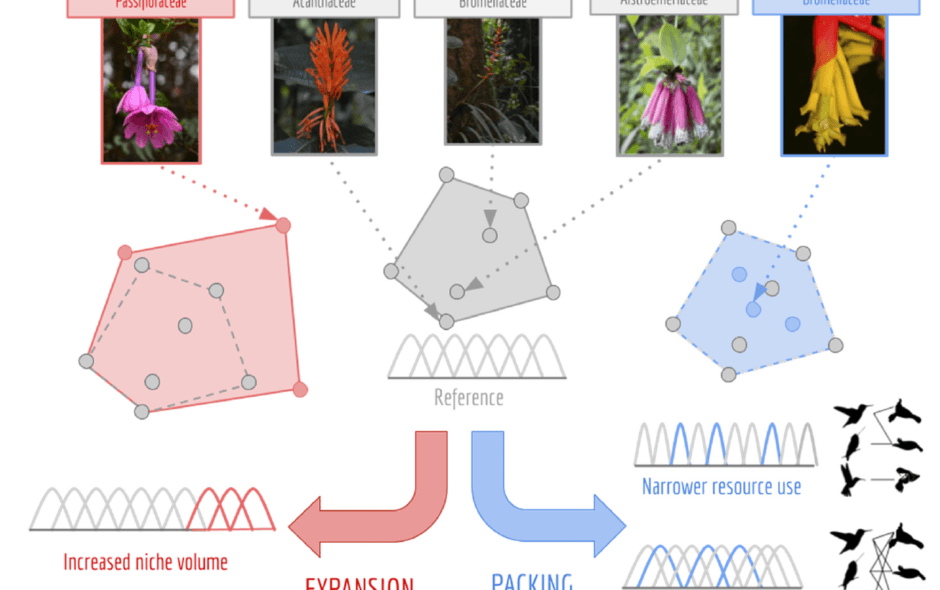
Tropical mountains often harbour high species richness. Yet the mechanisms behind such high richness remain poorly understood. One prominent hypothesis for high species richness is niche partitioning, which reduces competition and promotes coexistence. Here, we evaluate niche structure and specialisation of plant species based on the floral traits related to pollination interactions across an elevational gradient in the northern Andes. Niche structure can vary among sites, either expanding or contracting, or becoming more or less packed. We sampled eleven communities of hummingbird-visited plants along an elevation gradient in the Ecuadorian Andes and measured a series of functional traits associated with hummingbird pollination. We used the traits of all co-occurring species to calculate community weighted means, functional richness, and mean nearest neighbour distances and evaluated how they varied across elevation. Additionally, we measured specialisation based on plant–hummingbird interaction records to assess if packing is associated with narrower resource use or greater niche overlap. Species and functional richness were constant along the elevation gradient; however, niche packing was stronger at mid-elevation. We found changes in network specialisation, where the least specialised communities were those with higher niche packing. These results suggest that traits related to pollination and plant reproduction help to explain species co-occurrence and specialisation.

https://doi.org/10.1111/ecog.07440

Article

A Probabilistic View of Forbidden Links: Their Prevalence and Their Consequences for the Robustness of Plant–Hummingbird Communities

Duchenne et al. (2025) – Ecology Letters

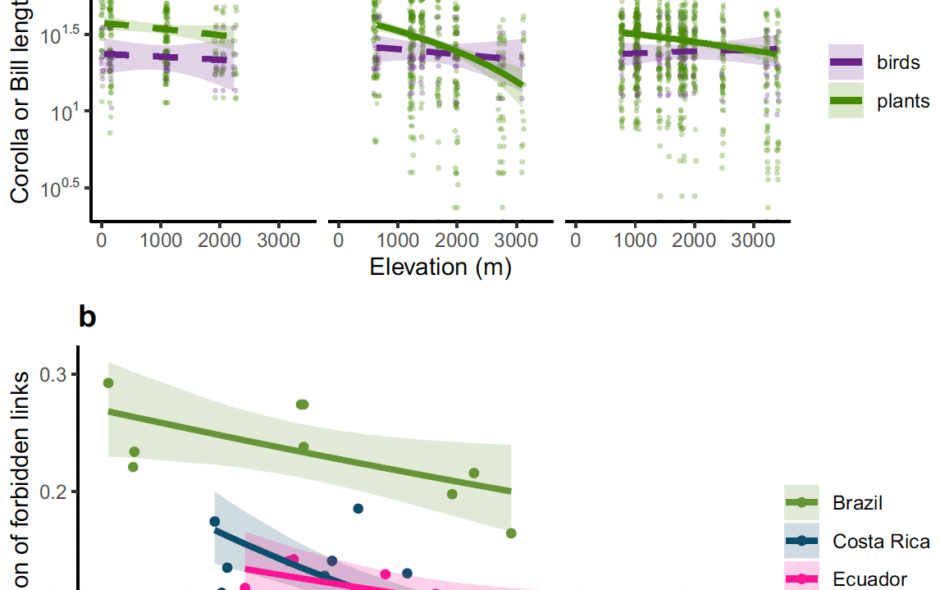
The presence in ecological communities of unfeasible species interactions, termed forbidden links, due to physiological or morphological exploitation barriers has been long debated, but little direct evidence has been found. Forbidden links are likely to make ecological communities less robust to species extinctions, stressing the need to assess their prevalence. Here, we used a dataset of plant–hummingbird interactions, coupled with a Bayesian hierarchical model, to assess the importance of exploitation barriers in determining species interactions. We found evidence for exploitation barriers between flowers and hummingbirds across the 32 studied communities; however, the proportion of forbidden links changed drastically among communities because of changes in trait distributions. The higher the proportion of forbidden links, the more they decreased network robustness because of constraints on interaction rewiring. Our results suggest that exploitation barriers are not rare in plant–hummingbird communities and have the potential to limit the rescue of species experiencing partner extinction.

https://doi.org/10.1111/ele.70073

Article

Macroevolution of the plant–hummingbird pollination system

Barreto et al. (2024) – Biological Reviews

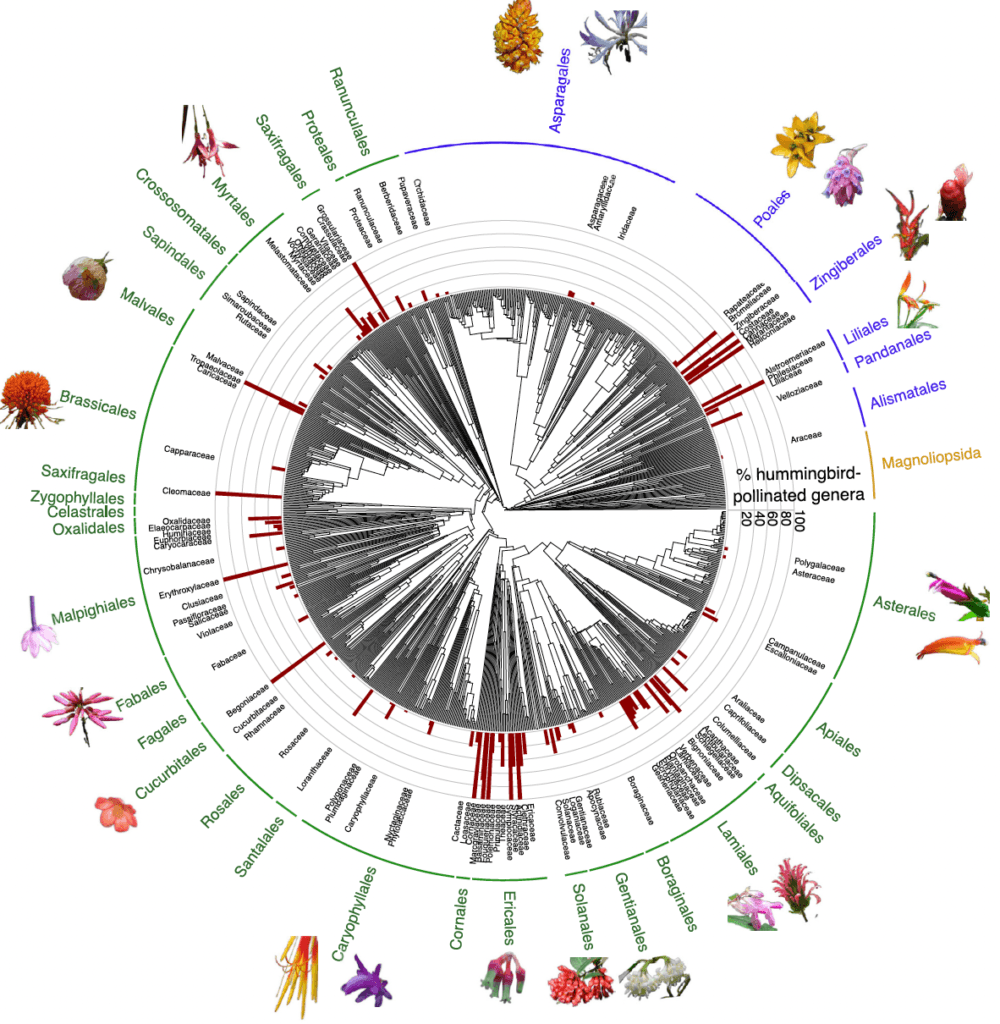
Plant–hummingbird interactions are considered a classic example of coevolution, a process in which mutually dependent species influence each other’s evolution. Plants depend on hummingbirds for pollination, whereas hummingbirds rely on nectar for food. As a step towards understanding coevolution, this review focuses on the macroevolutionary consequences of plant–hummingbird interactions, a relatively underexplored area in the current literature. We synthesize prior studies, illustrating the origins and dynamics of hummingbird pollination across different angiosperm clades previously pollinated by insects (mostly bees), bats, and passerine birds. In some cases, the crown age of hummingbirds pre-dates the plants they pollinate. In other cases, plant groups transitioned to hummingbird pollination early in the establishment of this bird group in the Americas, with the build-up of both diversities coinciding temporally, and hence suggesting co-diversification. Determining what triggers shifts to and away from hummingbird pollination remains a major open challenge. The impact of hummingbirds on plant diversification is complex, with many tropical plant lineages experiencing increased diversification after acquiring flowers that attract hummingbirds, and others experiencing no change or even a decrease in diversification rates. This mixed evidence suggests that other extrinsic or intrinsic factors, such as local climate and isolation, are important covariables driving the diversification of plants adapted to hummingbird pollination. To guide future studies, we discuss the mechanisms and contexts under which hummingbirds, as a clade and as individual species (e.g. traits, foraging behaviour, degree of specialization), could influence plant evolution. We conclude by commenting on how macroevolutionary signals of the mutualism could relate to coevolution, highlighting the unbalanced focus on the plant side of the interaction, and advocating for the use of species-level interaction data in macroevolutionary studies.

Barreto 2024
Macroevolution of the plant–hummingbird pollination system 10

https://doi.org/10.1111/brv.13094

Article

When cheating turns into a stabilizing mechanism of plant–pollinator communities

Duchenne et al. (2023) – PLOS Biology

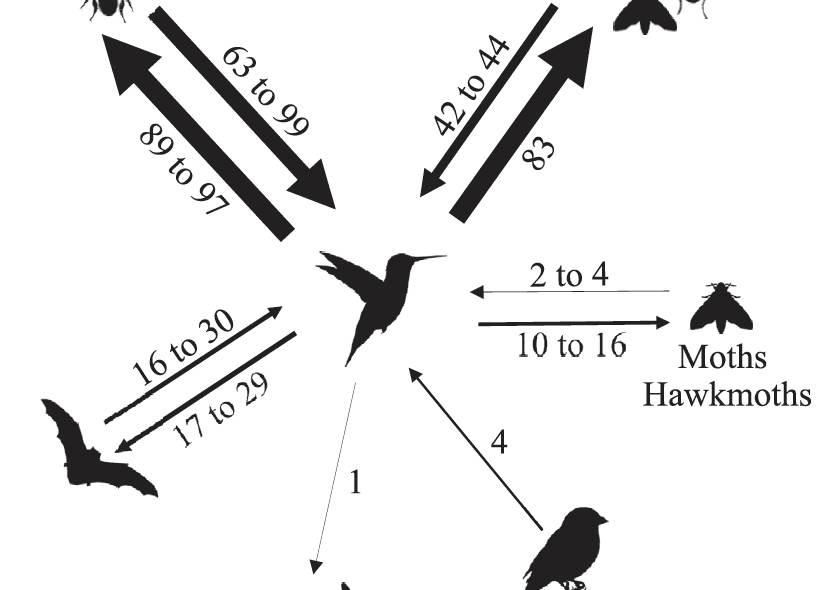
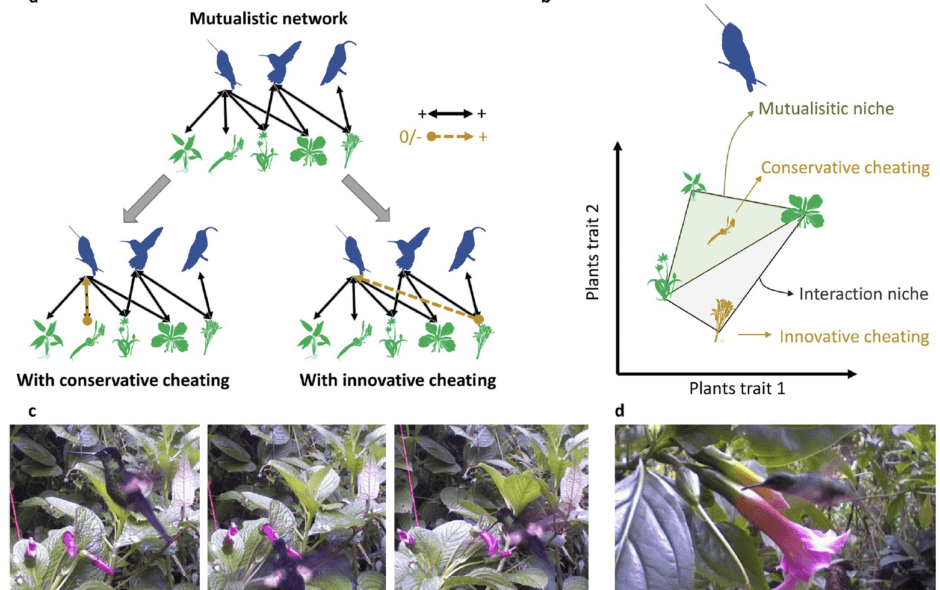
Mutualistic interactions, such as plant–mycorrhizal or plant–pollinator interactions, are widespread in ecological communities and frequently exploited by cheaters, species that profit from interactions without providing benefits in return. Cheating usually negatively affects the fitness of the individuals that are cheated on, but the effects of cheating at the community level remains poorly understood. Here, we describe 2 different kinds of cheating in mutualistic networks and use a generalized Lotka–Volterra model to show that they have very different consequences for the persistence of the community. Conservative cheating, where a species cheats on its mutualistic partners to escape the cost of mutualistic interactions, negatively affects community persistence. In contrast, innovative cheating occurs with species with whom legitimate interactions are not possible, because of a physiological or morphological barrier. Innovative cheating can enhance community persistence under some conditions: when cheaters have few mutualistic partners, cheat at low or intermediate frequency and the cost associated with mutualism is not too high. Under these conditions, the negative effects of cheating on partner persistence are overcompensated at the community level by the positive feedback loops that arise in diverse mutualistic communities. Using an empirical dataset of plant–bird interactions (hummingbirds and flowerpiercers), we found that observed cheating patterns are highly consistent with theoretical cheating patterns found to increase community persistence. This result suggests that the cheating patterns observed in nature could contribute to promote species coexistence in mutualistic communities, instead of necessarily destabilizing them.

https://doi.org/10.1371/journal.pbio.3002434

Article

The geography of climate and the global patterns of species diversity

Coelho et al. (2023) – Nature

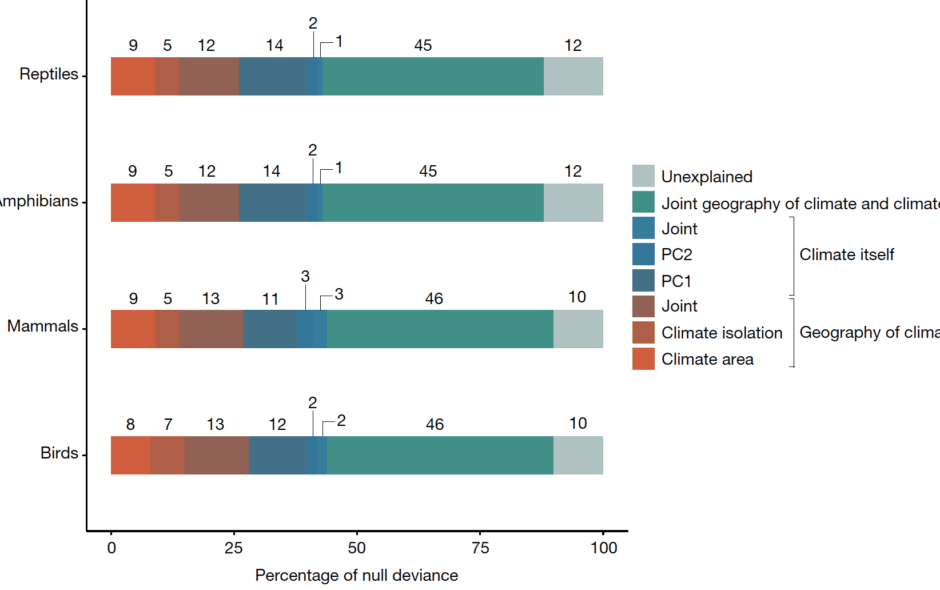
Climate’s effect on global biodiversity is typically viewed through the lens of temperature, humidity and resulting ecosystem productivity. However, it is not known whether biodiversity depends solely on these climate conditions, or whether the size and fragmentation of these climates are also crucial. Here we shift the common perspective in global biodiversity studies, transitioning from geographic space to a climate-defined multidimensional space. Our findings suggest that larger and more isolated climate conditions tend to harbour higher diversity and species turnover among terrestrial tetrapods, encompassing more than 30,000 species. By considering both the characteristics of climate itself and its geographic attributes, we can explain almost 90% of the variation in global species richness. Half of the explanatory power (45%) may be attributed either to climate itself or to the geography of climate, suggesting a nuanced interplay between them. Our work evolves the conventional idea that larger climate regions, such as the tropics, host more species primarily because of their size. Instead, we underscore the integral roles of both the geographic extent and degree of isolation of climates. This refined understanding presents a more intricate picture of biodiversity distribution, which can guide our approach to biodiversity conservation in an ever-changing world.

https://www.nature.com/articles/s41586-023-06577-5

Article

Morphology and niche evolution influence hummingbird speciation rates

Barreto et al. (2023) – Proceedings B

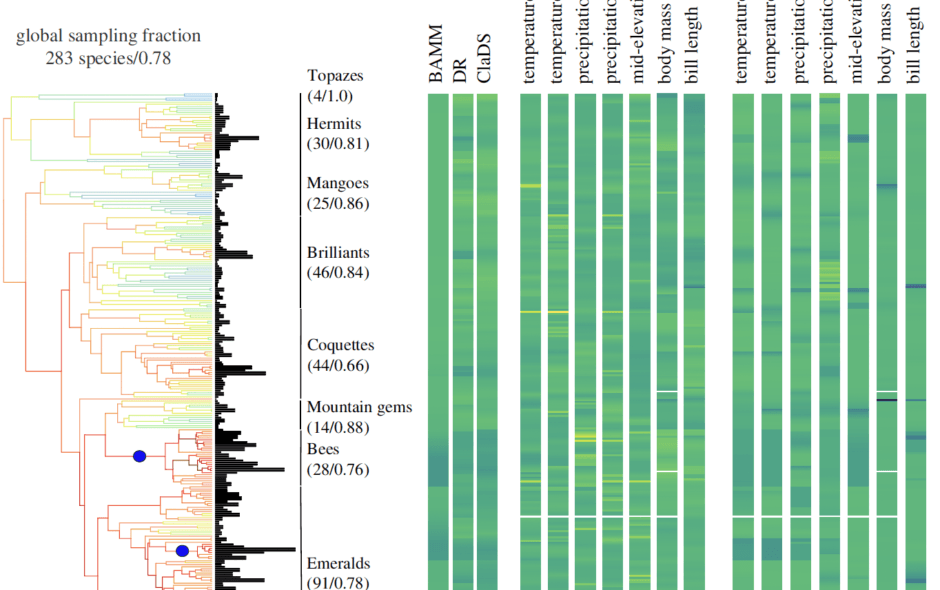
How traits affect speciation is a long-standing question in evolution. We investigate whether speciation rates are affected by the traits themselves or by the rates of their evolution, in hummingbirds, a clade with great variation in speciation rates, morphology and ecological niches. Further, we test two opposing hypotheses, postulating that speciation rates are promoted by trait conservatism or, alternatively, by trait divergence. To address these questions, we analyse morphological (body mass and bill length) and niche traits (temperature and precipitation position and breadth, and mid-elevation), using a variety of methods to estimate speciation rates and correlate them with traits and their evolutionary rates. When it comes to the traits, we find faster speciation in smaller hummingbirds with shorter bills, living at higher elevations and experiencing greater temperature ranges. As for the trait evolutionary rates, we find that speciation increases with rates of divergence in the niche traits, but not in the morphological traits. Together, these results reveal the interplay of mechanisms through which different traits and their evolutionary rates (conservatism or divergence) influence the origination of hummingbird diversity.

https://doi.org/10.1098/rspb.2022.1793

Article

PALEO-PGEM-Series: A spatial time series of the global climate over the last 5 million years (Plio-Pleistocene)

Barreto et al. (2023) – Global Ecology and Biogeography

Motivation

Climate change plays an important role in the generation and maintenance of biodiversity by driving processes such as diversification and range shifts. As a result, biodiversity patterns are often found to carry the imprints of palaeoclimatic changes. However, we still know little about the spatial and temporal variation in climate over the scale of millennia affecting eco-evolutionary dynamics, mostly because of the scarcity of user-friendly and freely available spatio-temporal palaeoclimate series at such temporal scales. Here, we address this gap by presenting PALEO-PGEM-Series, a global spatio-temporal dataset of the last 5 Myr, with 1 kyr resolution, spatially downscaled from emulations performed with the intermediate-complexity atmosphere–ocean general circulation model PALEO-PGEM. PALEO-PGEM-Series holds the potential to advance our understanding of the mechanisms behind the strong relationship between biodiversity and climate, a pressing need given projected biodiversity responses to anthropogenic climatic change.

Main Types of Variables Contained

Spatio-temporal series of monthly temperature and precipitation and 17 derived bioclimatic variables over the Pliocene–Pleistocene, along with standard error estimates from multiple runs of the emulator.

Spatial Location and Grain

Global landmasses, at 1° × 1°.

Time Period and Grain

Last 5 Myr at 1000 year resolution.

Software Format

Tab-delimited text files and accompanying R code to derive bioclimatic variables. We made available tab-delimited text files in FigShare (https://figshare.com/s/d45714f7212de7225fe2) containing monthly temperature (in degrees Celsius), monthly precipitation (in millimetres) and 17 bioclimatic variables estimated over the last 5 Myr every 1000 years.

https://doi.org/10.1111/geb.13683

Article

Accelerated body size evolution in upland environments is correlated with recent speciation in South American freshwater fishes

Cerezer et al. (2023) – Nature Communications

Speciation rates vary greatly among taxa and regions and are shaped by both biotic and abiotic factors. However, the relative importance and interactions of these factors are not well understood. Here we investigate the potential drivers of speciation rates in South American freshwater fishes, the most diverse continental vertebrate fauna, by examining the roles of multiple biotic and abiotic factors. We integrate a dataset on species geographic distribution, phylogenetic, morphological, climatic, and habitat data. We find that Late Neogene-Quaternary speciation events are strongly associated with body-size evolution, particularly in lineages with small body sizes that inhabit higher elevations near the continental periphery. Conversely, the effects of temperature, area, and diversity-dependence, often thought to facilitate speciation, are negligible. By evaluating multiple factors simultaneously, we demonstrate that habitat characteristics associated with elevation, as well as body size evolution, correlate with rapid speciation in South American freshwater fishes. Our study emphasizes the importance of integrative approaches that consider the interplay of biotic and abiotic factors in generating macroecological patterns of species diversity.

https://www.nature.com/articles/s41467-023-41812-7

Article

Safeguarding sloths and anteaters in the future: Priority areas for conservation under climate change

Borges et al. (2022) – Biotropica

Sloths and anteaters form the monophyletic order Pilosa, which is currently represented by only 16 extant species distributed exclusively in the Neotropics. This present-day low species richness is an inheritance of the Pleistocene megafaunal extinctions, where over 65 Pilosa species known from the fossil record went extinct. The large number of species lost in the recent past suggests that this group is greatly vulnerable to extinction. Here, we propose long-term priority conservation areas for the order Pilosa, considering different future climate change scenarios, biotic stability, and the multiple dimensions of the group’s biodiversity, such as species richness, species endemism, and phylogenetic diversity. Projections of species distribution for future scenarios show increased fragmentation and clear habitat loss as the Amazon Forest is replaced by savanna-like habitats. Conservation solutions were highly congruent for the different dimensions of biodiversity, with priority areas emerging mainly in the Atlantic Forest, Amazonian wetlands, highlands of Ecuador, and the Central American isthmus. Expanding the currently protected areas network by 6% with the proposed priority areas, independently of which future climatic scenario is considered, can increase sloths and anteaters’ coverage in the future by 12%. As a group of high phylogenetic and ecological importance, future conservation planning should deliberately aim to protect areas favorable to Pilosa, especially given the current scenario of environmental dismantling and neglect of critical Neotropical biomes.

https://doi.org/10.1111/btp.13185